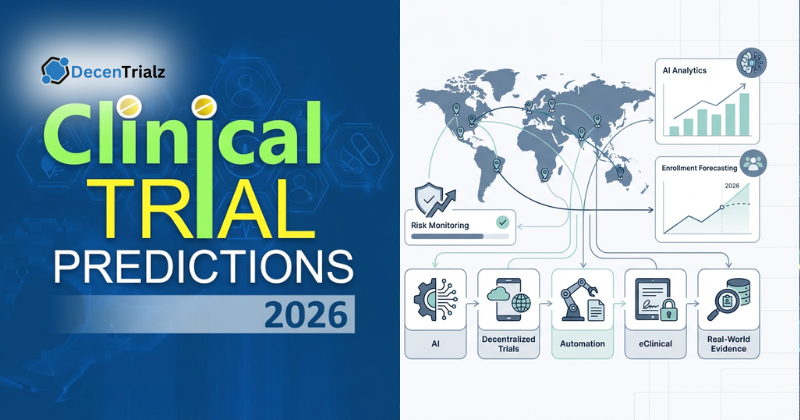
Clinical trial predictions 2026 suggest that technology has moved from being a support tool to becoming a foundational driver of how research is designed, executed, and monitored. Industry pressure to innovate continues to intensify as sponsors manage rising operational costs, compressed timelines, and increasing protocol complexity. At the same time, patients expect digital access, transparency, and reduced logistical burden when participating in research.
In 2026, digital transformation in clinical research is no longer experimental. AI systems, decentralized clinical trials, and automation platforms are embedded within operational frameworks. For sponsors, CROs, research sites, and healthcare technology leaders, clinical trial predictions 2026 now describe active realities rather than distant projections.
The Clinical Trial Landscape in 2026
Clinical trial predictions 2026 reflect a research environment defined by structural complexity and high data density. Protocols increasingly incorporate adaptive designs, biomarker-driven cohorts, and multi-regional recruitment strategies. These factors elevate coordination demands and require scalable, interoperable systems.
Growth in oncology, central nervous system (CNS), and cardiovascular programs, alongside precision therapies and biomarker-driven cohorts, intensifies these pressures. Smaller patient populations, adaptive dosing regimens, and high-cost investigational products with short shelf lives leave minimal margin for error in randomization, inventory, and scheduling.
North America remains the volume leader, while APAC continues to strengthen as a growth engine as local R&D investment and regulatory frameworks mature. Europe’s multi-country footprint supports complex global recruitment programs.
Data volumes per participant continue to expand. Wearables, imaging systems, electronic patient-reported outcomes, and EHR integrations generate continuous streams of information. The future of clinical trials now depends on operational models capable of managing and interpreting this scale of data in real time.
Recruitment remains competitive, particularly in oncology and rare disease programs. Variability in site technology adoption persists, reinforcing the need for harmonized data systems across sponsor and CRO networks.
AI and Predictive Analytics in Clinical Trial Predictions 2026
AI in clinical trials now plays a defined operational role. Clinical trial predictions 2026 show that AI-driven trial design tools are actively used to simulate enrollment scenarios, evaluate eligibility criteria feasibility, and forecast recruitment timelines before activation.
Predictive analytics in clinical trials supports patient matching by analyzing structured datasets alongside unstructured medical records. These systems accelerate technology-enabled recruitment while maintaining audit documentation and governance oversight.
Risk-based monitoring systems identify anomalous site performance trends and protocol deviations through real-time analytics. Rather than replacing human oversight, AI augments monitoring teams by prioritizing risk signals.
Clinical trial predictions 2026 confirm that AI adoption is expanding within structured compliance frameworks. Algorithm validation, bias assessment, and documentation protocols are now integrated into implementation strategies.
Decentralized and Hybrid Trials Becoming Standard
Decentralized clinical trials are embedded within mainstream development strategies. Clinical trial predictions 2026 indicate that hybrid clinical trials, combining site visits with remote participation, are standard across multiple therapeutic areas.
Remote patient monitoring through wearable devices, telehealth visits, and home health services reduces participant burden while maintaining protocol integrity. eConsent systems support transparent documentation. Digital health technologies facilitate structured, real-time data capture outside the clinical site.
Electronic Clinical Outcome Assessments (eCOA) and electronic PRO solutions are widely integrated, enabling consistent patient-reported data collection beyond traditional visits.
Operational coordination remains critical. Sponsors integrate telehealth providers, logistics vendors, and remote data systems into unified oversight structures. Regulatory authorities continue refining guidance to ensure decentralized models maintain data integrity and participant protection.
Clinical trial predictions 2026 reflect stabilization, not experimentation, of decentralized models.
Automation and Efficiency in Clinical Operations
Clinical trial automation is central to operational sustainability in 2026. Sponsors and CROs deploy clinical operations automation tools to manage workload complexity and cost pressure.
eSource systems reduce transcription errors and accelerate query resolution. Integration between EDC, CTMS, and safety systems minimizes redundant processes. Automated compliance tracking generates continuous audit readiness documentation.
As precision therapies expand, randomization and trial supply management (RTSM/IRT) platforms function as orchestration layers. These systems coordinate cohorts, manage inventory logistics, and adjust supply distribution across geographies in real time.
Clinical trial predictions 2026 show that automation now focuses on eliminating friction across multi-vendor ecosystems rather than digitizing isolated steps.
Data Integration, Real-World Evidence, and Advanced Analytics
Clinical trial predictions 2026 emphasize that trial data analytics and real-world evidence integration are structural capabilities. Sponsors combine trial data with EHR-derived insights, claims databases, and registries to strengthen feasibility modeling and post-market strategies.
Digital health technologies contribute continuous behavioral and physiological metrics that enhance analytical depth. Real-world evidence informs comparator selection, patient stratification, and long-term safety monitoring.
Sponsors increasingly deploy modular, cloud-native platforms with API-driven architectures. Integrated eClinical ecosystems now prioritize orchestration, connecting data streams, analytics layers, and oversight tools, rather than standalone capture systems.
Interoperability and governance frameworks remain decisive factors in extracting value from high-volume data environments.
Patient-Centric Clinical Trials in 2026
Patient-centric clinical trials now translate into measurable operational design. Clinical trial predictions 2026 show progress in simplifying eligibility criteria where scientifically appropriate, enhancing transparency in screening pathways, and prioritizing diversity in recruitment strategies.
Technology-enabled recruitment platforms improve targeted outreach while maintaining compliance with privacy regulations. Digital engagement systems support retention through reminders, structured communication, and real-time updates.
Sponsors balance convenience with protocol integrity. The emphasis in 2026 is not on marketing language but on measurable reductions in dropout rates and improved enrollment timelines.
Clinical trial predictions 2026 confirm that participant experience is now treated as an operational metric rather than a peripheral initiative.
Regulatory and Compliance Considerations
Technology integration continues under structured FDA oversight.
Clinical trial predictions 2026 highlight several compliance priorities:
- Strengthened global data privacy controls
- Formalized AI governance frameworks
- Transparent audit trails for automated systems
- Risk-based monitoring aligned with decentralized workflows
Regulators emphasize documentation, validation, and accountability. Organizations that embed compliance planning within technology deployment frameworks demonstrate greater operational stability.
Preparing for 2026: What Sponsors and Sites Should Focus On
Clinical trial predictions 2026 are relevant only when organizations translate insight into action.
Technology Selection Strategy
Prioritize interoperable, scalable platforms that support orchestration across eClinical systems.
Change Management
Align leadership, site networks, and CRO teams around standardized workflows.
Staff Training
Equip teams to interpret AI outputs and manage automated oversight systems.
Vendor Integration
Define API standards and cross-platform governance to avoid data silos.
Stakeholders seeking structured research ecosystem insights can explore resources for Sponsors, CROs, and Research Sites, as well as broader industry analysis available on the Blog and About Us pages.
Conclusion
Clinical trial predictions 2026 point to disciplined integration, not radical reinvention. Competitive advantage now belongs to sponsors and CROs who achieve agility and precision: managing complexity without excessive manual burden, pivoting efficiently across adaptive designs, and orchestrating multi-regional, precision-focused trials seamlessly.
Technology does not eliminate challenges, but in 2026 it enables the operational resilience required to navigate them effectively.
Explore How Technology Is Reshaping Clinical Research
Clinical trial predictions 2026 now reflect the operational baseline for sponsors, CROs, and research sites navigating increasing complexity. The strategic priority moving forward is refinement, orchestration, and sustainable integration across global clinical research ecosystems.
Stakeholders seeking structured alignment within evolving research environments can review ecosystem-focused collaboration approaches here.
For additional industry context shaping many of these clinical trial predictions 2026 insights, see the reference analysis from Clinical Trials Arena.
This external perspective reinforces how precision medicine, automation, decentralized models, and integrated eClinical ecosystems are defining the current phase of digital transformation in clinical research.
Leave a Reply