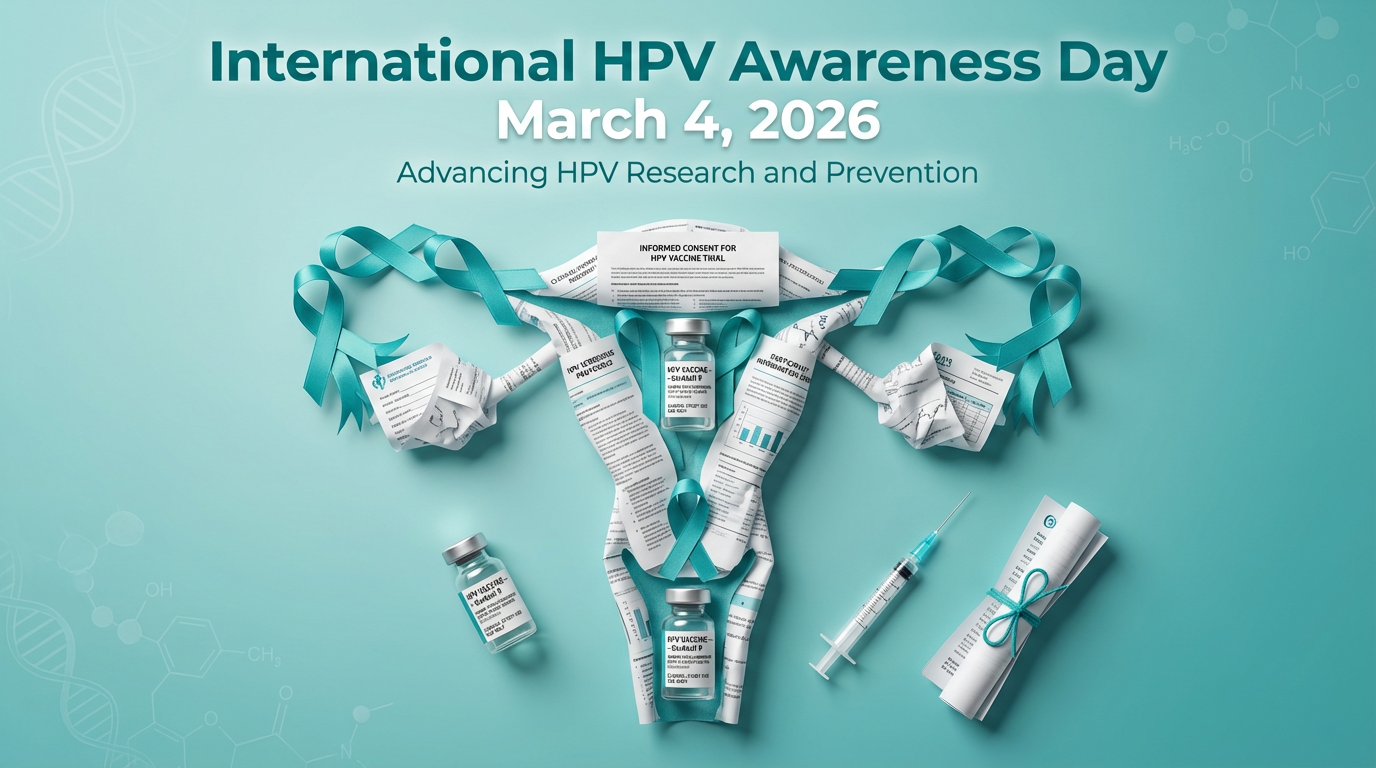
HPV clinical trials 2026 are advancing therapeutic vaccine innovation, cervical cancer immunotherapy, and precision treatment strategies for people facing HPV-related cancers.
On March 4, International HPV Awareness Day, a mother sits beside her daughter in an oncology clinic, quietly searching for answers. The diagnosis is HPV-related cervical cancer. According to the American Cancer Society, approximately 13,000 women in the United States are diagnosed with cervical cancer each year. Globally, HPV is responsible for nearly all cervical cancer cases, as reported by the World Health Organization.
International HPV Awareness Day is led by the International Papillomavirus Society and supported by awareness toolkits from the Centers for Disease Control and Prevention. While vaccination and screening campaigns remain essential, many families today are focused on something more immediate: access to active HPV clinical trials and cervical cancer research studies exploring new treatment possibilities.
Backed by research leadership from the National Cancer Institute, therapeutic HPV vaccine development and HPV immunotherapy trials are expanding rapidly. All of the studies below are verified in the national clinical trial registry and were active or recruiting at the time of publication.
These trials are not guaranteed treatment options. Participation always involves potential risks and benefits that must be reviewed carefully with your oncology team.
Below are five important HPV clinical trials you should know about this International HPV Awareness Day.
TRIAL 1 – Lenti-HPV-07 Therapeutic Vaccine Study
Can the Immune System Be Trained to Target HPV-Driven Cancer Cells?
Sponsor: Theravectys S.A.
What It Tests:
A lentiviral therapeutic HPV vaccine designed to stimulate T-cells to recognize and attack tumor cells that express HPV proteins.
Who It’s For:
Patients diagnosed with HPV-positive cervical cancer or HPV-related oropharyngeal cancers.
Locations:
Four research sites across academic cancer centers.
Lenti-HPV-07 is different from preventive HPV vaccines. Instead of preventing infection, it is designed to treat cancers already caused by HPV. The therapy uses a viral vector platform to teach the immune system to recognize specific HPV proteins that are present in tumor cells.
Researchers are enrolling 72 participants in this Phase 1/2a trial to study safety, immune activation, and early signals of tumor response.
Why It Stands Out
- Uses targeted immune activation against HPV oncogenic proteins
- Designed specifically for HPV-driven cancers
- Combines early safety evaluation with immune response monitoring
Therapeutic HPV vaccines are considered one of the most promising directions in HPV immunotherapy research.
What It Could Mean for Patients
For patients with HPV-related cancers, this study represents an investigational treatment approach that aims to train the immune system to recognize and attack cancer cells more effectively.
TRIAL 2 – TI-0093 Therapeutic Tumor Vaccine Study
Could Early-Stage HPV Immunotherapy Help Treat Advanced Tumors?
Sponsor: Therorna
What It Tests:
A Phase 1 dose-escalation therapeutic vaccine targeting HPV-16 driven tumors.
Who It’s For:
Patients with recurrent or metastatic HPV-16 positive solid tumors whose disease has progressed despite prior treatments.
Locations:
One research center participating in this early-phase trial.
TI-0093 is part of a growing class of therapeutic HPV vaccine approaches designed to activate immune responses against tumors caused by HPV-16.
In dose-escalation studies, researchers carefully increase the treatment dose in small groups of participants to monitor safety and determine the most appropriate dosage for future trials.
Although Phase 1 trials primarily focus on safety, they play a crucial role in advancing HPV treatment research studies toward larger clinical investigations.
Why It Stands Out
- Focuses on HPV-16, the most common cancer-causing HPV type
- Early research into tumor-targeted vaccine technology
- Helps establish safety and dosing for future trials
What It Could Mean for Patients
For individuals with advanced HPV-related cancers who have limited treatment options, early-phase trials like this one may contribute to the development of new immunotherapy strategies.
TRIAL 3 – PRGN-2009 + Pembrolizumab Combination Study
Can a Therapeutic Vaccine Restore Immunotherapy Response?
Sponsor: Precigen, Inc.
What It Tests:
PRGN-2009 therapeutic HPV vaccine combined with pembrolizumab compared with pembrolizumab alone.
Who It’s For:
Patients with recurrent or metastatic cervical cancer whose disease has stopped responding to pembrolizumab.
Locations:
Three clinical research sites in the United States.
Pembrolizumab is a commonly used immunotherapy for several cancers, including cervical cancer. However, some tumors eventually become resistant to treatment.
The PRGN-2009 cervical cancer study investigates whether adding a therapeutic HPV vaccine can help re-activate the immune system and restore anti-tumor responses.
By combining checkpoint inhibition with targeted immune stimulation, researchers hope to improve outcomes for patients with treatment-resistant disease.
Why It Stands Out
- Explores combination immunotherapy strategies
- Targets immune resistance in cervical cancer
- Focuses on patients with limited treatment alternatives
What It Could Mean for Patients
If the vaccine successfully enhances immune response, this approach could expand future treatment options for recurrent or metastatic cervical cancer.
TRIAL 4 – Reduced-Dose Radiotherapy for HPV-Positive Oropharyngeal Cancer
Could Lower Radiation Doses Maintain Effectiveness While Reducing Side Effects?
Sponsor: Georgetown University
What It Tests:
A de-escalation radiation strategy that uses lower radiation doses for early-stage HPV-positive oropharyngeal cancer.
Who It’s For:
Patients diagnosed with Stage I or Stage II HPV-positive oropharyngeal cancer.
Locations:
Two academic cancer research centers.
HPV-related head and neck cancers often respond very well to treatment. Because of this, researchers are studying whether full-intensity radiation is always necessary.
This Phase 2 study evaluates whether reduced radiation doses can maintain tumor control while reducing long-term side effects such as difficulty swallowing or speech problems.
Because treatment de-escalation is still investigational and not yet standard of care, careful monitoring is central to this research.
Why It Stands Out
- Focuses on preserving quality of life
- Investigates reduced treatment intensity
- Evaluates both survival outcomes and functional health
What It Could Mean for Patients
If successful, this approach could help some patients receive effective treatment with fewer long-term complications.
TRIAL 5 – BNT113 mRNA Therapeutic Vaccine Global Study
Could mRNA Technology Improve HPV-Related Cancer Treatment?
Sponsor: BioNTech SE
What It Tests:
An mRNA-based therapeutic HPV vaccine called BNT113 combined with pembrolizumab.
Who It’s For:
Patients with unresectable recurrent or metastatic HPV-16 positive head and neck squamous cell carcinoma.
Locations:
Approximately 189 research sites worldwide.
BNT113 uses mRNA technology designed to instruct the immune system to recognize HPV-related tumor antigens.
In this global Phase 2/3 trial, researchers are enrolling approximately 350 participants to compare pembrolizumab alone versus the combination of pembrolizumab and BNT113.
The study focuses on patients whose tumors express PD-L1, a protein often linked to immunotherapy response.
Why It Stands Out
- One of the largest ongoing HPV immunotherapy trials
- Uses mRNA vaccine technology
- Global study across nearly 200 research sites
What It Could Mean for Patients
If the combination therapy improves outcomes, it may influence future treatment strategies for HPV-related head and neck cancers.
How to Find HPV Clinical Trials Near Me
People often begin by searching “HPV clinical trials near me” or “HPV vaccine clinical trials 2026” and then struggle to interpret complex eligibility criteria and medical terminology.
While the national registry provides verified listings, navigating phases, eligibility rules, and geographic availability can feel overwhelming.
That is where DecenTrialz helps simplify discovery. Through its structured listing of active HPV clinical trials by condition, individuals can explore relevant studies in a clearer and more accessible way.
The platform works alongside sponsors and research sites to improve transparency and streamline trial visibility.
It also supports CRO partners, healthcare professionals, and advocacy groups that help connect patients to responsible clinical research opportunities.
A Community-Focused Close This International HPV Awareness Day
Help your community discover and apply for active HPV trials through DecenTrialz. Explore HPV Trials.
HPV clinical trials 2026 represent careful scientific progress, collaboration, and possibility for families navigating HPV-related cancers. If you or someone you love is facing an HPV-associated diagnosis, this International HPV Awareness Day can be a meaningful moment to speak with your care team and explore whether HPV clinical trials may be appropriate.
Leave a Reply