A Trial That Broke Boundaries
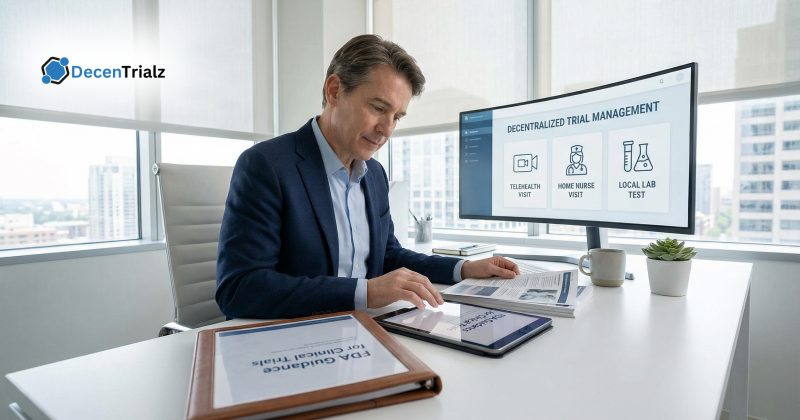
FDA guidance on decentralized clinical trials is reshaping how research is designed, monitored, and conducted across the United States. For instance, consider a late-stage heart failure study that decided to combine home nursing visits, telehealth check-ins, and local lab testing to make participation easier for patients. The idea was innovative, but within months, the research team realized new challenges had emerged. Local clinicians weren’t fully captured in the site logs, some assessments were split between virtual and in-person visits, and documentation of oversight became inconsistent.
That scenario is increasingly common as sponsors and sites embrace hybrid and remote elements in trials. It also helps explain why the FDA recently finalized new guidance on decentralized elements in clinical research. This new direction recognizes the hybrid model and provides a roadmap for adapting to it.
The guidance, titled Conducting Clinical Trials With Decentralized Elements – Guidance for Industry, Investigators, and Other Interested Parties, was issued in September 2024. It reflects a shift from labeling a trial as a “DCT” (decentralized clinical trial) to recognizing that many trials simply include remote or local elements.
In this post, we’ll walk through what the guidance means for sponsors and sites, major changes from the draft, and practical actions you can take now to align your trial programs.
What the FDA Guidance Means: Decentralized Elements vs “DCTs”
The new FDA guidance addresses decentralized clinical trials, hybrid trials, and the use of remote or local-based trial elements. But it doesn’t force a binary label on trials. Instead, it clarifies how the FDA views trials that include activities at locations other than traditional clinical trial sites, such as telehealth visits, in-home visits, and local labs.
The guidance provides recommendations for sponsors, investigators, and other interested parties regarding the implementation of decentralized elements in clinical trials. It is not a regulation but reflects the FDA’s current thinking on how to conduct trials with remote or local components while maintaining safety, data integrity, and regulatory oversight.
For sponsors and sites, the takeaway is clear: you don’t have to call your trial a “DCT” to fall under this guidance, but if you include remote or local components, you should design, document, and monitor accordingly.
To read the full text, visit the FDA’s Final Guidance on Conducting Clinical Trials With Decentralized Elements on the official FDA website.
Major Changes from the Draft – What’s New
Here are some of the key changes that differentiate the final guidance from the draft version:
- Removal of the “task log” requirement for local HCPs: The draft required a detailed log of local healthcare providers performing trial-related tasks. The final guidance removes that explicit requirement, clarifying that local HCPs are not necessarily trial personnel or sub-investigators when operating within their regular scope and performing tasks that do not require detailed knowledge of protocol or investigational product.
- Clarified oversight and delegation roles: Investigators must still ensure that local HCPs or other trial-related participants are supervised and that data coming in from remote or local sources is reviewed. The guidance provides clearer examples of how to do so and how to manage data variability.
- Data variability, remote visits, and flexibility: The guidance emphasizes that remote visits, local labs, digital health technologies, and in-home assessments are acceptable. Sponsors must address risks of variability, define in their protocols where activities occur (remote, site, or local HCP), and outline how they mitigate bias.
- Physical location for inspection access: The FDA continues to require that a physical location be identified where trial records can be inspected (whether paper or electronic) and where trial personnel can be interviewed in person or remotely. The final guidance offers more flexibility around how that location is identified.
These adjustments reflect both industry feedback and evolving realities of hybrid and remote trial conduct.
What Sponsors and Sites Should Do to Comply
While the FDA guidance does not create new legally binding obligations, it sets expectations. Here are actions sponsors, CROs, and sites should consider to align with the guidance:
- Review your protocol design
- Clearly identify which trial-related activities will be performed at a traditional site, which remotely (telehealth or home), and which via a local HCP or local laboratory.
- For each activity, define who performs it, where it occurs, how data is captured, and how you will mitigate variability.
- Clarify roles, delegation, and oversight
- Document how local HCPs will be engaged, what training they receive, how you will supervise their activities, and what documentation will be kept.
- Even when “task logs” aren’t required, ensure you keep records of local HCP names, dates, and tasks assigned.
- Ensure investigators are clear about their oversight responsibilities and that any delegated activities are documented.
- Ensure data integrity and monitoring
- For remote or home assessments or local lab visits, assess whether variability might be introduced (for example, home spirometry vs clinical spirometry) and build mitigation strategies such as training or video supervision.
- Draft a monitoring and oversight plan that covers decentralized elements, secure data transmission, and clarity of the origin of data (site, home, local lab).
- Identify inspection-ready location and access
- Designate a physical location or a clearly defined alternative where records are maintained and accessible to the FDA or other regulatory inspection bodies.
- Ensure your records system flags location type (remote vs site) and the person performing the activity.
- Update participant materials and logistics
- If the trial involves remote visits or home health, ensure informed consent and site materials reflect this.
- Consider technology access, local lab access, participant support such as shipping devices, digital health tools, and telehealth state-licensing implications.
- Train your team and sites
- Sponsors and CROs should train site staff, local providers, and remote personnel on the trial’s hybrid or decentralized elements, oversight model, and documentation requirements.
- Sites should review standard operating procedures (SOPs) to include remote or local visit workflows, telehealth check-ins, local lab integration, and participant logistics.
Why This Matters: Access, Efficiency, and Participant Experience
Embracing remote and local logistics isn’t just about convenience. It’s about participation, access, and modernization.
According to the guidance and industry analysis:
- Trials with decentralized elements may reach participants who cannot easily travel to large central sites, broadening geographic and demographic access.
- Hybrid and remote-capable trials can improve retention, reduce participant burden, and streamline operations, creating benefits for sponsors, CROs, and participants.
- By focusing on remote and local visit models, sponsors may better meet diversity, equity, and access goals and enhance the real-world relevance of results.
- For sites, adapting to decentralized elements means staying competitive, attracting more participants, and partnering in next-generation trial designs.
To learn more about how decentralized models are reshaping research, check out our earlier DecenTrialz blog What Are Decentralized Clinical Trials — And Why Sponsors Should Care?
How Technology and Platforms Can Support Your Strategy
While the FDA guidance frames expectations, the practical execution often comes down to systems and platforms. At DecenTrialz, we emphasize how modern trial platforms can:
- Enable remote visit scheduling and telehealth integration
- Track local lab and home visit workflows
- Flag delegate roles, location types, and visit origins (site, home, or local clinic)
- Support eConsent, electronic data capture (EDC), and audit-ready record-keeping aligned with regulatory requirements
These capabilities are not about claiming regulatory status. They are about facilitating modern trial conduct and building forward-looking, participant-centered trial models.
A Forward Look for Sponsors and Sites
The FDA’s final guidance on decentralized elements is less about revolution and more about evolution. It affirms that remote, home-based, and local lab visits are part of the trial future while emphasizing the need for design, oversight, documentation, and participant-centered logistics.
For sponsors and sites, the message is clear. Hybrid and remote elements are increasingly mainstream, but they come with design and oversight expectations. By getting ahead of these changes, you can improve access, enrich participant diversity, enhance retention, and reduce burden while aligning with regulatory best practices.