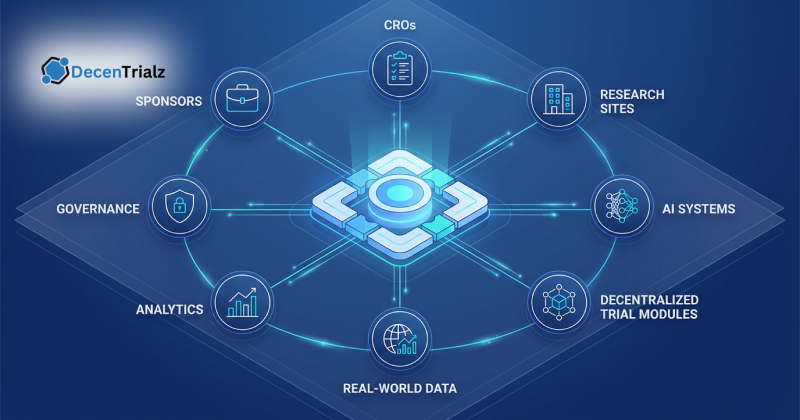
Clinical trials in 2026 are no longer defined by isolated systems and fragmented vendors, but by platformization, AI fluency, and an increasingly integrated research ecosystem.
What distinguishes 2026 from earlier digital experimentation is not the presence of new tools, but the structural redesign of research execution. Rising protocol complexity, global enrollment pressure, decentralized models, and tighter oversight expectations have made fragmented vendor stacks unsustainable.
Sponsors are demanding scalability. CROs are redefining service models. Technology vendors are consolidating into orchestration platforms.
Clinical trials in 2026 mark the transition from digital experimentation to architectural maturity.
The Shift Defining Clinical Trials in 2026
Digital transformation in clinical trials initially focused on tool adoption. EDC systems, CTMS platforms, decentralized modules, and analytics dashboards were layered onto legacy operating models.
This created vendor sprawl, parallel data repositories, manual reconciliation cycles, and limited cross-functional visibility.
In clinical trials in 2026, that fragmentation has become economically inefficient and strategically restrictive.
The future of clinical operations requires unified oversight across enrollment, monitoring, safety, data capture, and real-world evidence integration. Sponsors expect consolidated performance intelligence rather than stitched exports. CROs require scalable, platform-native environments.
The defining shift is structural consolidation, moving from tool layering to ecosystem integration.
What Platformization Means in Clinical Research
Platformization in clinical research is not modernization rhetoric. It represents infrastructure realignment.
Platformization includes:
- End-to-end clinical platforms spanning design through close-out
- API-based interoperability across EDC, eCOA, eSource, and analytics systems
- Centralized data governance environments
- Modular yet unified infrastructure
Trial technology platforms are evolving into integrated clinical ecosystems that reduce integration friction and increase operational transparency.
This impacts efficiency by reducing reconciliation loops, simplifies vendor management, and supports scalable portfolio expansion.
In clinical trials in 2026, platformization becomes the foundation for sustainable execution rather than a procurement exercise.
AI Fluency in Clinical Trials in 2026
AI in clinical trials has matured beyond experimentation. However, AI fluency in research is now the differentiator.
AI fluency in clinical trials in 2026 includes organizational literacy in model interpretation, formal validation frameworks, bias monitoring structures, and transparent governance oversight.
Predictive analytics in trials now support risk-based monitoring optimization, AI-powered patient matching, enrollment forecasting, and protocol feasibility simulation.
Yet AI in clinical trials delivers value only when paired with governance maturity.
AI fluency is a capability, not a feature.
Sponsors and CROs embedding data science oversight committees and validation protocols are better positioned to leverage AI responsibly within clinical trials in 2026.
The Redrawing of the Clinical Research Value Chain
The clinical research value chain is being restructured.
Sponsors increasingly seek centralized control over unified data environments. End-to-end clinical platforms reduce reliance on fragmented vendor silos and restore portfolio-level visibility.
CROs are repositioning toward strategic operational integration, platform-native execution, and data orchestration partnership.
Technology vendors are evolving into ecosystem orchestrators rather than isolated service providers.
Non-traditional players, including compounding pharmacies, telehealth providers, consumer wearables, and emerging payment models, are reshaping trial delivery and patient access. These entrants further emphasize platform strategy as sponsors seek unified visibility across diverse execution partners.
Clinical trials in 2026 redistribute influence across the clinical research value chain, with data ownership and ecosystem orchestration becoming competitive levers.
Sponsors, CROs, and Technology Realignment
Sponsor technology strategy in clinical trials in 2026 is shifting from vendor selection to ecosystem architecture.
Enterprise buyers are evaluating platform consolidation opportunities, hybrid infrastructure models, and centralized analytics ownership.
CROs must adapt to sponsor-led integrated environments where data transparency and cross-platform alignment are mandatory.
The economic model is shifting from transactional service fees toward infrastructure-based collaboration.
Decentralization Within Platform Ecosystems
Decentralized clinical trials have expanded remote visits, wearable integration, telemedicine, and site flexibility.
In clinical trials in 2026, decentralization is embedded within unified platforms rather than layered onto legacy systems.
Remote patient monitoring feeds directly into centralized analytics. Wearables integrate through standardized APIs. Telemedicine workflows synchronize with core trial management systems.
This integration reduces duplication and enhances compliance documentation.
Decentralized clinical trials become structurally aligned rather than operationally isolated.
Data Interoperability and Integration
Interoperability in clinical research has become strategic rather than aspirational.
Clinical trials in 2026 require harmonized data environments across EDC, eSource, safety systems, and real-world data integration.
Living protocols represent another structural advance. Rather than static amendments, 2026 platforms enable continuous protocol evolution through secondary data reuse and real-time feasibility modeling. ICH M11 standards and evolving ICH E6(R3) guidance accelerate this transition by standardizing modular trial design and execution.
Real-world data integration strengthens adaptive modeling and supports post-market strategy alignment.
Interoperability is now a governance capability supported by architectural discipline.
Risks and Governance in Platform-Driven Clinical Trials in 2026
Platform maturity introduces governance complexity.
Key considerations include AI bias and model transparency, vendor lock-in risk, cybersecurity exposure within centralized data lakes, and expanding regulatory scrutiny.
Alignment with FDA Digital Health Technology guidance
and evolving AI governance frameworks is essential.
Regulatory recovery continues through ICH M11 (modular protocols) and ICH E6(R3) revisions, enabling platform-native adaptive designs and automated compliance.
Clinical trials in 2026 require governance models that scale with infrastructure sophistication.
Preparing for Clinical Trials in 2026
Executive teams should approach this transition methodically.
Recommended actions include conducting enterprise-wide technology audits, mapping the full clinical research value chain, evaluating consolidation potential across trial technology platforms, establishing AI literacy programs, formalizing model governance structures, and developing interoperability scorecards.
Workforce roles are evolving toward data product ownership and AI governance specialists. Clinical operations teams increasingly require fluency in model interpretation, performance validation, and cross-platform data orchestration.
Clinical trials in 2026 demand alignment between architecture, governance, and organizational capability.
Structured Platforms and Trial Visibility
Platforms that centralize and structure publicly available clinical trial information reinforce transparency, interoperability, and platform-aligned research execution across sponsor and CRO ecosystems.
Preparing for the Platform-Driven Future
Clinical trials in 2026 reflect structural realignment rather than incremental innovation.
Platformization in clinical research, AI fluency in research, living protocols, decentralized integration, and value chain redistribution are converging to redefine the future of clinical operations.
Organizations that treat technology as infrastructure, not experimentation, will maintain strategic control, operational clarity, and competitive resilience in clinical trials in 2026.