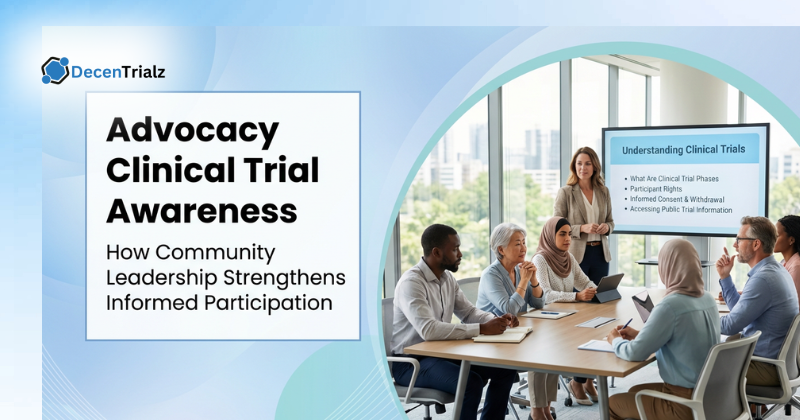
Advocacy clinical trial awareness influences whether communities view research as an opportunity for informed choice or as an unfamiliar system to approach cautiously. Patient advocacy organizations and community health leaders frequently serve as the first point of contact for individuals seeking clarity about clinical studies. Long before enrollment decisions are made, community conversations shape understanding, trust, and expectations around research participation.
In many therapeutic areas, individuals encounter research through advocacy newsletters, support groups, educational webinars, or peer networks rather than institutional messaging. Structured advocacy-led trial education ensures these early touchpoints provide balanced, accurate, and ethically grounded information.
Trust is the foundation of participation. Without it, even well-regulated studies struggle to engage communities. With it, informed participation becomes possible. As healthcare systems emphasize equity, transparency, and diversity, community-based research awareness is no longer optional. It is essential.
Why Advocacy Clinical Trial Awareness Matters for Community Trust
Advocacy clinical trial awareness directly affects community trust in clinical research. Historical injustices, limited transparency, and patterns of underrepresentation have contributed to skepticism in certain populations. These concerns influence whether individuals explore trial information access or disengage entirely.
Community leaders often act as interpreters between research institutions and patients. They translate complex scientific language into accessible explanations and raise critical questions when clarity is lacking. This mediation role makes patient advocacy and research participation closely interconnected.
Trust barriers commonly stem from:
- Limited understanding of regulatory oversight
- Confusion around eligibility and exclusion criteria
- Misinterpretation of randomization or placebo use
- Concerns regarding privacy and data handling
When advocacy clinical trial awareness addresses these issues proactively, communities feel respected rather than targeted. Transparency strengthens confidence. Clear explanations of informed consent, withdrawal rights, and safety monitoring reinforce autonomy.
Many established patient advocacy groups clinical trials initiatives include tracking open studies in their disease area to provide members with accurate, balanced updates. This structured approach supports research participation awareness without pressuring individuals to enroll.
Building Education Frameworks for Patient Education Trials
Effective advocacy-led trial education requires structure. Informal updates are insufficient to build lasting clinical trial literacy.
Strong frameworks often include:
- Educational workshops explaining research phases and oversight
- Plain-language guides defining key terminology
- Balanced discussions of risks and potential benefits
- Question-and-answer sessions with clinicians or research coordinators
For example, a regional breast cancer advocacy organization may host quarterly forums explaining how randomization works, what placebo controls mean, and how screening determines eligibility before presenting any specific trial listings. Education precedes opportunity.
Explaining eligibility criteria is particularly important. Many individuals assume they will not qualify due to misconceptions. Clarifying inclusion standards supports patient education trials by improving accuracy in self-assessment.
Advocacy clinical trial awareness becomes more effective when embedded in continuous education rather than introduced only when new studies open.
Strengthening Community Trust Through Responsible Outreach
Community-based research awareness must reflect cultural and social realities. Language barriers, literacy levels, and historical experiences shape how research messages are received.
Responsible outreach includes:
- Providing materials in multiple languages
- Adapting content to different health literacy levels
- Acknowledging past concerns transparently
- Engaging community representatives in message review
Improving clinical trial awareness requires equitable trial information access. Underrepresented communities should receive the same depth of explanation and clarity as any other group.
Community trust in clinical research grows when outreach is relational rather than transactional. Advocacy leaders who encourage questions and openly address uncertainties strengthen credibility over time.
Ethical Boundaries in Advocacy Clinical Trial Awareness
Maintaining ethical boundaries is essential. Advocacy clinical trial awareness must remain distinct from recruitment efforts unless formally structured and transparently disclosed.
Awareness explains research processes and rights. Recruitment seeks enrollment into a specific study. Educational messaging should avoid creating urgency or emotional pressure.
Respect for autonomy is central to informed participation. Individuals must feel free to decline without judgment or social consequence.
Transparency in funding relationships protects integrity. If advocacy initiatives receive research-related support, disclosure aligns with ethical recruitment practices and strengthens trust.
Balanced communication reinforces that clinical trials are designed to answer scientific questions. They are not guarantees of benefit.
Responsible Resource Sharing and Trial Information Access
Advocacy groups frequently guide members toward reliable sources. Responsible resource sharing strengthens clinical trial literacy while preserving neutrality.
Best practices include:
- Linking to publicly accessible registries
- Presenting eligibility criteria without interpretation
- Avoiding exaggerated or speculative claims
- Encouraging consultation with healthcare providers
Condition-based clinical trial listings are available through our clinical trials page.
Community-oriented research education articles and structured trial literacy discussions are available on our blog page.
Patient-focused drug development resources are available through the U.S. Food and Drug Administration.
Organizations seeking collaboration opportunities may review our advocacy engagement information.
Providing structured trial information access supports understanding without influencing personal decisions.
Addressing Misinformation and Building Clinical Trial Literacy
Misinformation spreads quickly, particularly through informal digital channels. Advocacy clinical trial awareness must proactively address common myths.
Frequent misconceptions include:
- Participants cannot withdraw once enrolled
- Clinical trials are only for last-resort treatment
- Safety monitoring is minimal
- Data privacy protections are weak
Advocacy leaders can improve clinical trial awareness by hosting open discussions, publishing evidence-based summaries, and collaborating with trusted experts.
Clinical trial literacy develops over time. Education before enrollment conversations reduces fear and supports rational evaluation.
Understanding clinical trials before enrolling ensures decisions are informed rather than reactive.
Supporting Informed Participation Without Pressure
Supporting informed participation requires empowerment rather than persuasion.
Advocacy groups can strengthen decision-making by:
- Encouraging thorough consent discussions
- Explaining visit schedules and follow-up commitments
- Clarifying compensation policies neutrally
- Reinforcing voluntary withdrawal rights
How advocacy groups support clinical trials ultimately depends on maintaining community credibility. When communication emphasizes clarity, transparency, and autonomy, research participation awareness grows organically.
How Structured Information Platforms Support Advocacy Efforts
Platforms that present publicly available clinical trial information in structured and searchable formats can support advocacy clinical trial awareness by improving clarity and accessibility.
Organizing research by condition, location, or eligibility criteria enables community leaders to guide individuals toward reliable sources without interpreting outcomes. Structured digital systems complement advocacy-driven research education and enhance trial information access.
Technology strengthens community leadership when used responsibly.
Advocacy clinical trial awareness is grounded in ethics, transparency, and community leadership. It strengthens patient education trials, builds clinical trial literacy, and reinforces community trust in clinical research.
Advocates build research confidence by:
- Educating communities before enrollment conversations begin
- Clarifying rights, risks, and oversight transparently
- Distinguishing awareness from recruitment
When communities understand how research works, participation becomes informed rather than pressured.
Leave a Reply